
1-Step vs 2-Step Prop Firm Challenge: Which One Fits?
The whole 1-step versus 2-step debate compresses into one sentence: fewer phases cost more upfront and fund you faster, more phases cost less upfront and test you longer. Everything else is detail, and the detail is where firms differ.
This guide goes through both formats with our actual numbers, including the parts that are usually left off comparison pages: what the fees really unlock, why a single 10 percent phase is not the shortcut it looks like, and the third format that most comparisons skip entirely.
The trade-off in one sentence
An evaluation exists to answer one question: can this trader make a profit target without breaching risk limits? A 2-step challenge asks that question twice on the same account, so the fee is lower and the filter is stricter. A 1-step challenge asks it once, so you pay more for the attempt and reach the funded stage sooner.
What does not change between the formats, at least here, is everything after the pass. Funded rules, payouts, risk categories: identical. You are choosing the shape of the test, not the prize.
Our 2-step: 8 percent, then 6 percent, no clock
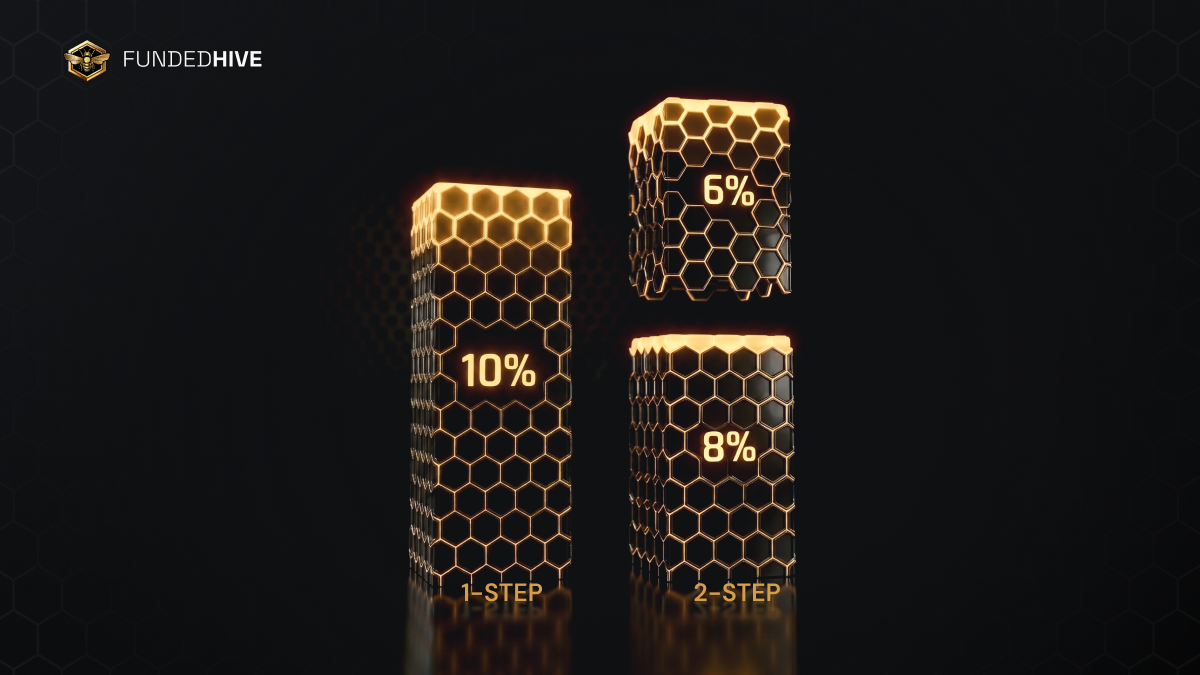
The 2-step evaluation runs on two consecutive phases: an 8 percent profit target in Phase One, then 6 percent in Phase Two. The risk limits stay constant throughout: a maximum loss per trade of 3 percent, calculated from the balance at the moment the trade opens, a daily loss limit of 5 percent resetting at 00:00 UTC, and an overall loss limit of 10 percent. All limits are balance-based and static, and there is no equity-based drawdown and no consistency rule.
Three things about our version that are not universal in the industry:
- No time limit on either phase. You can take a week or six months. A profit target with a deadline is a different and harder target, because it forces trades. Ours does not.
- Three profitable days per phase. A day counts when it earns at least 1 percent of the initial balance, and only while your balance is at or above the initial balance. This is the pacing requirement, and it applies to the evaluation only, never to the funded stage.
- News trading and weekend holding are allowed during the challenge, and copy trading between your own accounts is permitted on challenge phases.
The 2-step comes in two flavours. Classic uses a single upfront fee that covers everything through to the funded stage, with profit shares of 70, 80 or 90 percent depending on the account tier. Pay From Profits uses small access fees instead, and moves the big fee to the other side of the pass, which is where the price math gets interesting.
Our 1-step: 10 percent once, then risk categories take over
The 1-step Pay From Profits challenge has a single phase with a 10 percent profit target. Same 3 percent maximum loss per trade, same 5 percent daily limit, same 10 percent overall limit, same absence of a time limit. Pass it and you are through in one move.
What happens next is the part comparison sites rarely explain. On both Pay From Profits formats, the system assigns you a risk category after you pass, based on how you actually traded the evaluation: Low, Moderate, Medium or High. The category is assigned automatically and cannot be chosen. It determines your funded fee, your leverage and whether a stop loss is required. Trade the evaluation with tight stops and small risk, and you land in a cheaper, higher-leverage category. Trade it aggressively and the funded stage prices that in.
This matters for the 1-step decision specifically, because a single 10 percent phase tempts people to push size. The pass and the category are measured on the same trades. Winning the sprint recklessly costs you at the next step.
The price math with real numbers
These are the current Pay From Profits access fees by account size:
| Account size | 2-step access fee | 1-step access fee |
|---|---|---|
| $5,000 | $9 | $19 |
| $10,000 | $19 | $39 |
| $25,000 | $49 | $99 |
| $50,000 | $75 | $149 |
| $100,000 | $99 | $249 |
| $200,000 | $199 | $399 |
Read the numbers with their conditions, because the conditions are the honest part:
- On the 2-step, each phase has its own access fee. Passing Phase One unlocks Phase Two against the next access fee, payable within 14 calendar days of the pass.
- The access fee is not the funded fee. It covers the evaluation itself: platform access, liquidity connection, portal services. The funded account fee is separate, set by your assigned risk category at 1 to 3 percent of the account size. In concrete terms, a $5,000 funded account starts at $49 and a $100,000 one at $999, and on Low and Moderate categories the fee is paid entirely out of your first profits rather than upfront. Medium and High categories pay half upfront.
- Passing refunds double. A successful challenge returns 200 percent of the fee in Hive Coins, which can cover up to half the price of future challenges.
- Failing refunds nothing. Access fees on unsuccessful challenges are not refunded, which is standard across the industry and worth saying plainly anyway.
So the real comparison is not $9 versus $19. It is: the 1-step charges roughly double per attempt for one gate instead of two, and both routes still pass through the same risk category pricing on the far side.
Why one 10 percent phase is not easier than 8 plus 6
The arithmetic looks friendly. Ten percent once against roughly 14.5 percent compounded across two phases: the 1-step needs less total profit. But the difficulty of an evaluation is not the size of the target, it is the ratio between the target and the room you have to reach it.
Both formats give you the same 10 percent overall loss limit. On the 1-step you are asking for a 10 percent gain inside a 10 percent loss corridor, in one continuous run, with no intermediate checkpoint. On the 2-step, Phase One asks for 8 percent inside the same corridor, and then the slate resets: Phase Two starts fresh, and its 6 percent target is the easiest stretch of either format. The second phase is not a second hurdle so much as a second life.
There is also a psychological asymmetry that shows up in real behaviour. A trader down 4 percent in a single-phase challenge knows one drawdown stands between them and a lost fee, and that knowledge produces exactly the oversized recovery trades that finish accounts. The phase structure of a 2-step spreads that pressure across two smaller commitments.
None of this makes the 1-step a trap. It makes it a payment for speed: you are buying fewer weeks between purchase and funded status, not an easier exam.
The third option comparisons ignore
Most 1-step versus 2-step articles pretend those are the only two shapes. There is a third: no evaluation phases at all.
InstantGrowth starts you trading immediately on a $10,000 account and scales through 10 levels, each requiring a 6 percent profit target. The risk frame is different from the challenges: a 6 percent static balance-based maximum drawdown, a 2 percent maximum loss per trade, and no daily loss limit at all. Level 1 works as a verification stage, and from Level 2 upward execution runs through our Automated A-Book Dealing System. From the second level on, each upgrade fee, at 2 percent of the new balance, is paid from the profits of the previous level rather than from your pocket.
The trade-off is symmetrical with everything above: you skip the evaluation entirely, and in exchange the account is smaller at the start and the drawdown corridor is tighter. It suits traders who would rather prove themselves on a live ladder than in an exam room.
Which one fits you
- Pick the 2-step if you trade a steady system, you are cost-sensitive, and the extra phase does not bother you. It is the cheapest route per attempt, and the phase reset works in your favour. If you also trade with tight stops, the Low risk category on the far side means the funded fee comes entirely from profits.
- Pick the 1-step if your edge is proven and your priority is time to funding. Pay for speed deliberately, and resist the temptation to treat one phase as permission to double your risk, because the risk category system is watching the same trades.
- Pick InstantGrowth if evaluations feel artificial to you and you want to be trading toward scale from day one, inside a tighter drawdown.
- Pick Classic if you want the simplest possible deal: one fee upfront, two phases, no funded fee afterwards, and profit share up to 90 percent by tier.
Frequently asked questions
Is a 1-step challenge easier to pass than a 2-step?
Not meaningfully. It requires less total profit, but you earn it inside the same loss limits in one continuous run, with no phase reset. It is faster, not easier.
Do the funded rules differ after a 1-step or 2-step pass?
No. Both Pay From Profits routes lead to the same funded stage, with a risk category assigned from your evaluation behaviour determining fees, leverage and stop loss requirements.
Is there a time limit on FundedHive challenges?
No. Neither format has a time limit on any phase. The only pacing requirement is three profitable days per evaluation phase, defined as days earning at least 1 percent of the initial balance while the balance is at or above its starting level.
What happens after I pass a Pay From Profits challenge?
The system assigns your risk category, and you have 14 days to activate the funded account, with a one-time extension of up to 30 additional days available on request. On Low and Moderate categories the funded fee is deducted from your first profits rather than paid upfront.
Are the challenge fees refundable?
Not on failed challenges. On passed challenges, 200 percent of the fee is returned in Hive Coins, usable to cover up to 50 percent of future challenge purchases.
The bottom line
The 2-step is the value route: lowest fees, a mid-course reset, and the strongest position if you trade conservatively. The 1-step is the speed route at double the fee. InstantGrowth removes the exam entirely for a tighter corridor. All three end at the same funded rules and the same under-60-second payouts.
Current prices for every account size are on the pricing page, and the full rules are in our FAQ. New traders can use the code WELCOME25 for 25 percent off.
Trading involves risk and profits are not guaranteed. FundedHive provides a simulated evaluation environment and is not a broker. Profit targets, fees, risk categories and payout conditions are governed by our terms and the applicable product annexes, which prevail over any summary on this page. Figures reflect our terms effective January 2026 and can change, so always check the pricing page and terms for current numbers.